

wide-and-deep-net-california-housing-v2
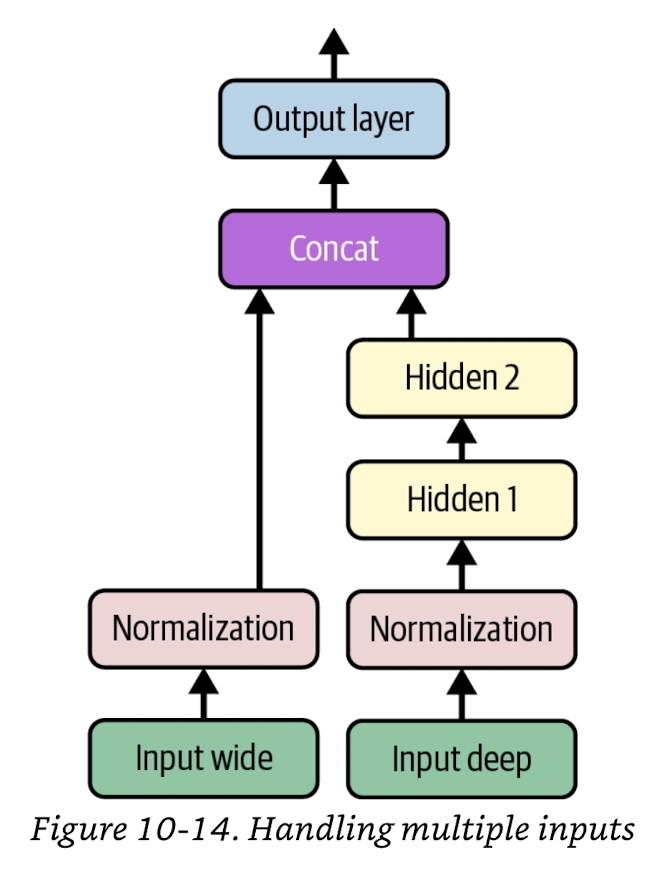
A wide & deep neural network trained on the California Housing dataset.
It takes eight features: 'MedInc', 'HouseAge', 'AveRooms', 'AveBedrms', 'Population', 'AveOccup', 'Latitude' and 'Longitude'. It predicts 'MedHouseVal'.
The first five features ('MedInc', 'HouseAge', 'AveRooms', 'AveBedrms' and 'Population') flow through the wide path.
The last six features ('AveRooms', 'AveBedrms', 'Population', 'AveOccup', 'Latitude' and 'Longitude') flow through the deep path.
Note: The features 'AveRooms', 'AveBedrms' and 'Population' flow through both the wide path and the deep path.
This model is a PyTorch adaptation of the TensorFlow model in Chapter 10 of Aurelien Geron's book 'Hands-On Machine Learning with Scikit-Learn, Keras, and TensorFlow'.
Experiment tracking: https://wandb.ai/sadhaklal/wide-and-deep-net-california-housing
Usage
from sklearn.datasets import fetch_california_housing

housing = fetch_california_housing(as_frame=True)

from sklearn.model_selection import train_test_split

X_train_full, X_test, y_train_full, y_test = train_test_split(housing['data'], housing['target'], test_size=0.25, random_state=42)
X_train, X_valid, y_train, y_valid = train_test_split(X_train_full, y_train_full, test_size=0.25, random_state=42)

X_means, X_stds = X_train.mean(axis=0), X_train.std(axis=0)
X_train = (X_train - X_means) / X_stds
X_valid = (X_valid - X_means) / X_stds
X_test = (X_test - X_means) / X_stds

import torch

device = torch.device("cpu")

import torch.nn as nn
from huggingface_hub import PyTorchModelHubMixin

class WideAndDeepNet(nn.Module, PyTorchModelHubMixin):
    def __init__(self):
        super().__init__()
        self.hidden1 = nn.Linear(6, 30)
        self.hidden2 = nn.Linear(30, 30)
        self.output = nn.Linear(35, 1)

    def forward(self, input_wide, input_deep, label=None):
        act = torch.relu(self.hidden1(input_deep))
        act = torch.relu(self.hidden2(act))
        concat = torch.cat([input_wide, act], axis=1)
        return self.output(concat)

model = WideAndDeepNet.from_pretrained("sadhaklal/wide-and-deep-net-california-housing-v2")
model.to(device)
model.eval()

# Let's predict on 3 unseen examples from the test set:
print(f"Ground truth housing prices: {y_test.values[:3]}")
new = {
    'input_wide': torch.tensor(X_test.values[:3, :5], dtype=torch.float32),
    'input_deep': torch.tensor(X_test.values[:3, 2:], dtype=torch.float32)
}
new = {k: v.to(device) for k, v in new.items()}
with torch.no_grad():
    preds = model(**new)
print(f"Predicted housing prices: {preds.squeeze()}")
Metric
RMSE on the test set: 0.5606
This model has been pushed to the Hub using the PyTorchModelHubMixin integration.